Best Quality Peptide: Raw Material Characteristics & Preclinical Research Overview
On this site the phrase best quality peptide is a technical shorthand, not a recommendation and not a ranking. It refers to measurable attributes of laboratory-grade high-purity research peptide raw material: confirmed molecular identity, high chromatographic purity, a stated net peptide content, a characterised counter-ion and residual solvent profile, lot traceability, and analytical work that another laboratory could in principle repeat. Where this page uses the phrase, it means those attributes and nothing else. It does not describe what a peptide does, and it is never used here to place one source of material above another.
The material here is an independent third-party academic review of what the public literature reports about research peptide raw material quality, how analytical laboratories characterise it, and how industry and community discussion frames quality standards. The site sells nothing, recommends no company, ranks no source and accepts no advertising. BPC 157, GHK-Cu, collagen peptides and sermorelin are not approved as medicines by the FDA or the EMA, and retatrutide is an investigational compound. No statement here describes human use, and no amount, route, schedule or preparation procedure appears on any page.
Three conventions run through the text. Figures such as molecular weight are attributed to the reporting that published them, because sources round them differently and counter-ion and hydration shift the measured value. Where the literature is unsettled, the text says so instead of choosing a side. And where a quality claim cannot be checked against a primary record, it is described as unverified.
All content on this page focuses on public laboratory research and quality trait analysis of research-grade peptides. No medical advice, product recommendation, or purchasing guidance is provided. All peptides discussed are for laboratory research use only.
Top Page Short Disclaimer
All content on this page focuses on public laboratory research and quality trait analysis of research-grade peptides. No medical advice, product recommendation, or purchasing guidance is provided. All peptides discussed are for laboratory research use only.
What Are Best Quality Peptides? (Research-Grade Definition)
A research-grade peptide is a synthetic amino acid chain made for laboratory investigation, usually by solid-phase peptide synthesis, in which the chain is assembled residue by residue on an insoluble support, cleaved, purified and isolated as a lyophilised solid. The output is not a single uniform substance: it is the target sequence together with related impurities, including deletion sequences, truncated chains, residual cleavage reagents, counter-ions and water. Characterising that mixture is what peptide quality work consists of.
Read this way, best quality describes how completely a lot has been characterised and how well it matches its specification, not what the peptide does. Two lots of the same sequence can carry the same name and differ in purity, in net peptide content, in counter-ion load and in residual solvent. That difference is invisible in a name and visible only in analytical data, which is why public discussion of quality keeps returning to certificates of analysis and to independent retesting rather than to product names.
It also helps to separate research-grade material from neighbouring categories. Clinical trial material is made under good manufacturing practice against a regulatory dossier. Research-grade material is not held to that standard, and a research use only label is a statement about the intended setting rather than a quality grade, although the two are routinely conflated in public writing. A third category, hydrolysed protein material such as collagen peptide, is not a sequence at all but a distribution of fragments, so its quality questions differ in kind from those for a defined synthetic sequence.
Core Quality Traits of Laboratory-Grade Research Peptides
The traits below are the ones that recur across analytical writing on research peptides. They are grouped by what is measured, how it is measured, and how the figure is commonly reported. A chromatographic purity percentage and a net peptide content percentage are different quantities, and a reader who takes the first for the second will misjudge how much peptide is in a weighed mass.
Purity by HPLC is the most widely reported number. Research-grade material is commonly reported at 95 percent or above, and higher specification material is frequently labelled at 98 to 99 percent, as reported in analytical writing. That figure describes the proportion of peak area attributable to the target peak under one method, on one column, at one wavelength. It does not confirm identity, and it says nothing about how much of the vial is peptide rather than water, salt or counter-ion. Net peptide content is a separate measurement, usually by amino acid analysis, and it is what matters when a mass is converted to a molar amount.
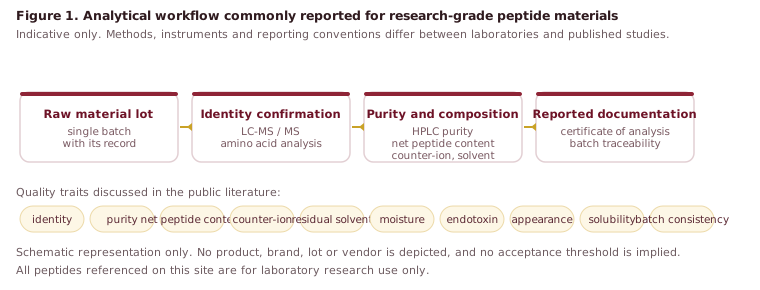
| Attribute | Common analytical method | How it is commonly reported |
|---|---|---|
| Identity | LC-MS or MALDI-TOF mass spectrometry | Observed mass matched against the theoretical mass of the stated sequence, with amidation or lipidation noted |
| Chromatographic purity | Reversed-phase HPLC with UV detection at 214 to 220 nm | Percentage of peak area; research-grade commonly 95 percent or above, higher specification often 98 to 99 percent |
| Net peptide content | Amino acid analysis after hydrolysis, or nitrogen determination | Percentage of the weighed mass that is peptide, reported separately from purity |
| Counter-ion | Ion chromatography, NMR or capillary electrophoresis | Stated as trifluoroacetate or acetate, sometimes with a molar ratio |
| Residual solvent | Headspace gas chromatography | Reported per solvent, in parts per million or as a percentage by mass |
| Water content | Karl Fischer titration | Percentage by mass, reported separately from residual solvent |
| Endotoxin | Limulus amebocyte lysate based assays | Endotoxin units per milligram, where reported at all |
| Related impurities | HPLC with peak tracking, LC-MS of individual peaks | Deletion, truncated and modified species, individually or as a total |
| Storage and stability | Stability studies under stated temperature and humidity | A storage condition and a retest or expiry date |
| Documentation and lot record | Certificate of analysis issued per lot | Lot identifier, methods used, acceptance limits, date of testing, any third-party retest report |
- Identity: confirmed by mass spectrometry against the theoretical mass of the stated sequence.
- Purity: reported by HPLC as a percentage of peak area, with the method named.
- Net peptide content: reported separately from purity, since the two answer different questions.
- Counter-ion: stated as trifluoroacetate or acetate, because it affects both mass and handling.
- Water and residual solvent: measured separately, by Karl Fischer titration and by headspace gas chromatography.
Research Overview of High-Quality Peptide Varieties
The five categories below are the ones most often discussed under the best quality peptide phrase in research writing and open discussion. They are not comparable objects: four are defined synthetic sequences of known length, one is a hydrolysate distribution. The table states molecular figures as commonly reported rather than as fixed constants, since salt form, counter-ion and hydration shift the measured value and different sources round it differently.
A second caution applies to naming. Public discussion compresses a sequence, a salt form and a label style into one name, then compares materials that were never the same substance. Checking a certificate of analysis against the sequence is the only way to confirm that two descriptions refer to the same molecule.
| Category | Sequence length or composition | Molecular weight as commonly reported | Common analytical methods | Quality focus specific to the category |
|---|---|---|---|---|
| BPC 157 | Pentadecapeptide, 15 residues, a fragment of a body protection compound reported in gastric juice | Approximately 1419.5 g/mol, formula C62H98N16O22 as commonly reported | Reversed-phase HPLC, LC-MS identity | Completeness of the chain and stability in solution |
| GHK-Cu | Tripeptide glycyl-L-histidyl-L-lysine with copper, usually described as a 1:1 complex | GHK approximately 340.4 g/mol, formula C14H24N6O4; the complex reported separately | HPLC, mass spectrometry, copper determination | Copper stoichiometry and the stated ratio |
| Collagen peptides | A mixture of hydrolysed fragments, not a sequence; rich in glycine, proline and hydroxyproline | Average values commonly reported in the low kDa range, often 2 to 6 kDa by hydrolysis conditions | Size exclusion chromatography, amino acid analysis | The distribution and the hydrolysis behind it |
| Retatrutide | Investigational 39-residue peptide LY3437943 with a fatty diacid side chain for albumin binding | Approximately 4.7 kDa as commonly reported | LC-MS, HPLC, peptide mapping | Side chain integrity and lipidated impurities |
| Sermorelin | GHRH(1-29) amide, 29 residues | Approximately 3357.9 g/mol as commonly reported | HPLC, mass spectrometry, amino acid analysis | C-terminal amidation and chain completeness |
Best Quality BPC 157 Peptide: Identity and Analytical Trait Summary
BPC 157 is described in the literature as a pentadecapeptide of fifteen residues, reported as a fragment of a body protection compound found in gastric juice. The molecular formula is commonly reported as C62H98N16O22 and the molecular weight as approximately 1419.5 g/mol. Those figures anchor identity work: a mass that does not match the theoretical mass of that sequence indicates a different sequence, a modification, or a counter-ion and salt effect that has not been accounted for.
The quality questions that recur are whether the chain is complete, whether deletion and truncated sequences are resolved by the method actually used, and how the material behaves in solution over time. A purity figure from one laboratory is not directly comparable with another's if the column or the wavelength differs, so net peptide content should be reported alongside it.
Best Quality GHK-Cu Peptide: Identity and Analytical Trait Summary
GHK-Cu is the copper complex of the tripeptide glycyl-L-histidyl-L-lysine. The peptide is reported with the formula C14H24N6O4 and a molecular weight of approximately 340.4 g/mol, and the complex with copper is usually described as 1:1 in the descriptive literature. Stoichiometry is the question that distinguishes this material, because a preparation can contain the correct peptide and still differ in how much copper is associated with it, and that difference is invisible in a peptide purity figure.
A fuller characterisation reports more than a chromatogram: peptide identity by mass spectrometry, chromatographic purity, and a copper determination with the ratio stated. Colour and appearance are recorded too, since the complex looks different from the free peptide.
Best Quality Collagen Peptide: Composition and Analytical Trait Summary
Collagen peptide material is not a sequence but a hydrolysate, a distribution of fragments produced by breaking down collagen, and it is characterised by that distribution. Average molecular weight values are commonly reported in the low kDa range, often between 2 and 6 kDa depending on hydrolysis conditions, which makes the value a property of a process as much as of a material. Composition is reported as an amino acid profile rich in glycine, proline and hydroxyproline.
That changes what quality means. A synthetic peptide is graded on how closely it approaches one defined molecule; a hydrolysate is graded on whether its distribution and composition are consistent across lots. Two materials sharing an average can still have very different distributions.
Best Quality Retatrutide Peptide: Identity and Analytical Trait Summary
Retatrutide, also identified as LY3437943, is an investigational 39-residue peptide acting on the glucose-dependent insulinotropic polypeptide, glucagon-like peptide-1 and glucagon receptors. Its molecular weight is commonly reported at approximately 4.7 kDa, and published descriptions note a fatty diacid side chain supporting albumin binding. It is an investigational compound and is not approved as a medicine in any jurisdiction this site is aware of.
Length and lipidation both raise the analytical difficulty: a 39-residue chain carries more scope for deletion and truncation, and the fatty diacid side chain adds a class of impurity that a method built for an unmodified peptide may not resolve. Characterisation typically combines high-resolution mass spectrometry, reversed-phase HPLC and peptide mapping. With no public reference standard, a purity figure is one laboratory's observation.
Best Quality Sermorelin Peptide: Identity and Analytical Trait Summary
Sermorelin is the amide of the first 29 residues of growth hormone-releasing hormone, written GHRH(1-29) amide, with a molecular weight commonly reported at approximately 3357.9 g/mol. The C-terminal amidation is part of the identity rather than a detail: it changes the mass and the behaviour of the chain, so a characterisation that confirms residue composition without confirming the amidated terminus has not fully confirmed the molecule under discussion.
Quality reporting therefore states the amidation explicitly and supports it with mass spectrometry. The practical concerns are chain completeness, resolution of deletion sequences, and the counter-ion and net peptide content that determine how much of a weighed mass is actually peptide.
Best Quality Peptide Formulations & Raw Material Types
Formulation language in this field is loose, and the same word is used for a physical form, a container and a specification. This section separates three things usually mixed together: the physical form of the raw material, the analytical questions that form raises, and the documentation that should accompany it. No form described here is presented as preferable to another, and the existence of a form in the literature says nothing about what the peptide does in any model.
Most research peptide material leaves synthesis in solution, is purified by preparative chromatography and isolated by lyophilisation. From there it may stay a cake, be milled into a powder, or be combined with excipients and compressed. Each step adds a handling variable: humidity, contact with surfaces, mixing with material that is not peptide, so a specification written for the material leaving the column is not automatically the specification for the material in the container.
| Raw material type | Physical description | Analytical questions specific to the form | Documentation usually attached |
|---|---|---|---|
| Lyophilised solid in a vial | A cake or loose solid, white to off-white | Water content after lyophilisation, recovery on dissolution, closure integrity | Certificate of analysis per lot with identity, purity and net peptide content |
| Bulk powder | Free-flowing solid, sometimes blended from several runs | Blend homogeneity, segregation, water uptake on exposure | Lot record, specification sheet, sometimes a blend record |
| Hydrolysed protein powder | Spray-dried or granulated hydrolysate, as with collagen peptide | Molecular weight distribution, ash and moisture, microbiological limits | Composition profile, average molecular weight as reported, amino acid profile |
| Solution | Peptide in a stated solvent or buffer at a stated concentration | Stability in that solvent, adsorption to the container, microbial growth | Concentration, solvent identity, storage condition and retest date |
| Excipient-containing compressed form | Peptide with fillers, compressed into a tablet or similar unit | Recovery from the matrix, content uniformity across units | Content per unit, excipient list, and the recovery method used |
Best Quality Collagen Peptide Powder: Characterisation Traits for a Hydrolysate
Best quality collagen peptide powder, in the sense used here, means a hydrolysed collagen raw material whose distribution and composition are documented and consistent across lots. Because the material is a distribution rather than a sequence, the powder form adds two concerns that a defined synthetic peptide does not raise to the same degree: moisture uptake, since hydrolysate powders are often hygroscopic, and homogeneity, since a powder may be blended from more than one production run.
The characterisation usually reported includes an average molecular weight with the method stated, a distribution rather than a single number, an amino acid profile with glycine, proline and hydroxyproline, and moisture and ash values. Colour, odour and solubility are recorded too, since they change fastest on storage. For research use the practical point is that an average is a summary of a distribution, and two powders sharing it may not be interchangeable in work that depends on fragment size.
Industry & Community Discussion on Peptide Quality Standards
Public discussion of peptide quality happens in three overlapping places: industry and standards writing, the documentation accompanying material, and open forums and social platforms. This page regards all three as objects of study rather than as sources of measurement. It does not repeat specific claims, does not name commercial sources, and does not verify or endorse anything said in them.
One structural point explains most of what follows. The attributes set out in the second section can only be checked against a document, and that document is produced by or for the party that made the material. Public discussion is therefore an argument about how much weight an unverified document can carry. Independent third-party retesting is the usual response, but it moves the question rather than closing it, since that laboratory's own method and acceptance limits also have to be stated.
Best Quality Peptide Companies: What Public Industry Sources Describe
This site does not rank, recommend, endorse or compare any company, supplier or brand, and it publishes no list of sources. The phrase best quality peptide companies is used here only as the search phrase under which this subject is discussed. What can be described is the shape of public industry writing on standards: standards bodies and analytical laboratories publish methods and acceptance criteria for identity, purity, counter-ion, residual solvent and water, and documentation issued with material is built around them.
The differences between documents are differences of completeness. Some state the HPLC method, the column and the wavelength; others state only a percentage. Some report net peptide content separately; others leave a stated mass ambiguous. A reader is usually comparing how much of the method was disclosed.
Best Quality Peptides Online: How to Read Public Research Data
Searching for best quality peptides online returns three kinds of material, frequently not distinguished from one another. The first is primary literature indexed in databases such as PubMed, which states a method and an observation and can in principle be checked. The second is documentation issued with material, which states a figure but usually not a full method. The third is commentary, which states neither.
A practical test is to ask what each would let a reader repeat. A paper naming the column, gradient and wavelength can be reproduced; a certificate giving a percentage without a method cannot; commentary giving neither cannot be checked at all. Where a figure has no method attached, the honest description is unverified rather than wrong.
Best Quality Peptides Reddit: Themes in Open Community Discussion
Threads found under the phrase best quality peptides reddit, and under similar phrases on other open platforms, cluster around recurring themes. The most common is third-party testing: whether an independent laboratory has repeated the identity and purity work, and whether that report is published in full. The second is the certificate of analysis itself, and whether the method behind a stated percentage is disclosed. The third is the purity convention, meaning the widespread confusion between chromatographic purity and net peptide content.
Discussion also returns to lot consistency, to whether a retest reproduces the first figure, and to storage of lyophilised material. This page summarises themes only: it has not verified any statement in any thread, does not repeat specific claims, does not identify posters, and regards none of it as evidence. The limits are those of anonymous uncontrolled reporting: no credential can be checked, no comparator exists, and a description cannot be traced to a lot.
Published Research Citations (E-E-A-T Academic Backing)
The references below are database searches rather than citations to individual papers. That is deliberate: a search URL resolves to whatever the database currently indexes, so a reader sees the live record rather than a number this page asserts, and the error of attaching an identifier to a paper that may not say what a summary claims is avoided. Readers should follow the searches and read the primary sources.
Four clusters of search terms cover the ground this page draws on. The first covers method: peptide purity by HPLC, mass spectrometric identity confirmation, amino acid analysis, Karl Fischer water determination. The second covers molecules, with searches under BPC 157, GHK-Cu, collagen hydrolysate characterisation, retatrutide and sermorelin. The third covers specification language, including net peptide content, trifluoroacetate counter-ion, residual solvent limits and endotoxin testing. The fourth covers stability and storage of lyophilised peptide material.
- PubMed search: peptide purity HPLC analysis
- PubMed search: peptide identity mass spectrometry confirmation
- PubMed search: net peptide content amino acid analysis
- PubMed search: trifluoroacetate counter-ion in synthetic peptides
- PubMed search: residual solvent determination in peptide material
- PubMed search: Karl Fischer water determination lyophilised peptide
- PubMed search: endotoxin testing of peptide research material
- PubMed search: BPC 157 pentadecapeptide
- PubMed search: GHK-Cu copper tripeptide complex
- PubMed search: collagen hydrolysate molecular weight distribution
- PubMed search: retatrutide LY3437943
- PubMed search: sermorelin GHRH 1-29 amide
- PMC search: research peptide quality control analytical methods
- PMC search: peptide stability and lyophilised storage
General Research & Industry Limitations (Authority Safeguard)
The limits below apply to every section on this page and are not specific to any one molecule. The first is definitional. Best quality as used here is a bundle of analytical attributes, and pages elsewhere that use the phrase for ranking are using a different definition. Nothing here ranks or recommends, and no statement should be read as a comparative judgement about any source.
The second is documentary. Almost every quality figure in public circulation originates in a document produced by or for the party that made the material. A percentage without a method, a column and a wavelength cannot be reproduced, and a purity figure without a net peptide content does not say how much of a weighed mass is peptide. Third-party retesting helps but does not close the problem, because that laboratory's own method and limits also have to be disclosed.
The third is the gap between analytical quality and research meaning. A well-characterised lot answers what is in the container; it does not answer what the peptide does in any model, and it says nothing about behaviour in people. BPC 157, GHK-Cu, collagen peptides and sermorelin are not approved as medicines by the FDA or the EMA, retatrutide is an investigational compound, and no human amount, route, schedule or preparation procedure appears here. Public discussion moves faster than the literature, so a figure without a method should be regarded as unverified.
Frequently Asked Questions
What is best quality peptide?
On this site the phrase best quality peptide means laboratory-grade high-purity research peptide raw material, defined by measurable attributes rather than by opinion. Those attributes are confirmed molecular identity by mass spectrometry, chromatographic purity by a stated HPLC method, a net peptide content reported separately, a characterised counter-ion and residual solvent profile, water content, lot traceability, and where available independent third-party retesting. It describes how completely a lot has been characterised, not a ranking of any source and not a statement about what the peptide does.
What are the traits of best quality peptides?
The traits fall into four groups. Identity traits: the observed mass matches the theoretical mass of the stated sequence, and modifications such as amidation or a lipid side chain are confirmed. Purity traits: a chromatographic purity figure, commonly reported at 95 percent or above for research-grade material and often 98 to 99 percent for higher specification material, reported together with the method used. Composition traits: net peptide content, counter-ion, residual solvent and water reported separately. Documentation traits: a certificate of analysis tied to a lot identifier, a storage condition, a retest date, and ideally an independent retest report.
What is the best quality BPC 157 peptide?
BPC 157 is a pentadecapeptide of fifteen residues, reported as a fragment of a body protection compound found in gastric juice, with a molecular formula commonly reported as C62H98N16O22 and a molecular weight of approximately 1419.5 g/mol as commonly reported. Describing a lot of this material as high quality means that its identity matches that sequence by mass spectrometry, that its chromatographic purity is reported with the method used, that deletion and truncated sequences are resolved, and that net peptide content and counter-ion are stated. Public preclinical writing on the peptide is a separate body of work from that characterisation.
What is the best quality GHK Cu peptide?
GHK-Cu is the copper complex of the tripeptide glycyl-L-histidyl-L-lysine. The peptide is reported with the formula C14H24N6O4 and a molecular weight of approximately 340.4 g/mol as commonly reported, and the complex with copper is usually described as 1:1 in the descriptive literature. The quality question specific to this material is copper stoichiometry, because a preparation can contain the correct peptide and still differ in how much copper is associated with it. A fuller characterisation therefore reports peptide identity by mass spectrometry, chromatographic purity, and a copper content determination with the ratio stated.
What is the best quality collagen peptide powder?
Collagen peptide powder is a hydrolysate, a distribution of fragments rather than a single sequence, so quality here means a documented and lot-consistent distribution instead of a match to one defined molecule. Average molecular weight values are commonly reported in the low kDa range, often between 2 and 6 kDa depending on hydrolysis conditions, and the composition is reported as an amino acid profile rich in glycine, proline and hydroxyproline. A complete description states the average with the method used, gives a distribution rather than a single number, and reports moisture and ash, since hydrolysate powders are often hygroscopic.
What companies offer best quality peptide raw materials?
This site does not rank, recommend, endorse, evaluate or compare any company, supplier or brand, and it does not publish a list of sources. What it can describe is the standard such material is measured against: identity by mass spectrometry, chromatographic purity by a stated method, net peptide content reported separately from purity, counter-ion and residual solvent limits, water content by Karl Fischer titration, endotoxin where relevant, a resolvable lot identifier, and independent third-party retesting. Any document that omits the method behind a stated percentage cannot be checked, and this site has not verified any documentation issued by anyone.
Where can public research data on best quality peptides online be found?
Primary data is indexed in literature databases. Searches under peptide purity HPLC, peptide identity mass spectrometry, net peptide content, trifluoroacetate counter-ion, residual solvent limits, and lyophilised peptide stability return the analytical work behind the traits described on this page. Molecule-specific searches under BPC 157, GHK-Cu, collagen hydrolysate characterisation, retatrutide and sermorelin return the identity literature. Documentation found elsewhere, including certificates of analysis and open commentary, should be read as an unverified record unless it states the method, and this site does not host or verify any such document.
What do Reddit discussions say about best quality peptides?
This page has not verified any statement made in any thread, does not repeat specific claims and does not identify posters. The recurring themes in open discussion under phrases such as best quality peptides reddit are consistent: whether an independent third-party laboratory has repeated the identity and purity work and published the full report; whether a certificate of analysis discloses the method behind a stated percentage; and the widespread confusion between chromatographic purity and net peptide content. Discussion also returns to lot consistency, to whether a retest reproduces the first figure, and to storage and handling. None of it is regarded here as evidence.
Does this site publish price, cost or discount code information for best quality peptides?
No. This site publishes no price information, no cost comparisons, no discount codes and no pricing guidance of any kind, and it does not track what anyone charges for research peptide material. Material is not sold here, nothing is recommended, and no commercial relationship is disclosed or implied. The only subject covered is quality characterisation as described in the public analytical literature: identity, purity, net peptide content, counter-ion, residual solvent, water content, lot traceability and third-party retesting. Any figure of that kind found elsewhere should be regarded as unverified.
Does this site handle shipping, payment or refunds for peptide materials?
No. This site does not sell, does not act as an agent or intermediary, does not take payment, does not ship anything and does not process refunds. It has no commercial function of any kind and no relationship with any supplier. It is an independent academic review of research peptide raw material quality attributes, analytical methods and public discussion. Any page elsewhere that presents this site as a seller or as an intermediary is misrepresenting it.
Editor & Research Review Information
Content aggregated from long-term observation of peptide industry quality standards, public academic research, and community research discussions. All quality-related descriptions are based on public laboratory research data, peer-reviewed studies, and industry public technical indicators, and every summary is published with the limitation statement that qualifies it.
| Written by | Peptide Raw Material Research Editor |
| Reviewed by | Analytical Chemistry Research Contributor |
| Last updated | 2026-09-15 |
| Scope | Public quality-trait literature on research-grade peptides |
| External citations | Public research records (PubMed / NCBI) |
Bottom Full Disclaimer
This site specializes in public academic overview and quality characteristic analysis of laboratory-grade best quality peptides. All content is for educational and research reference only. No brand endorsement, vendor recommendation, medical function claim, or human usage instruction is included. All research peptides mentioned are not approved for human medical use.
Question about the quality traits described here? The editorial desk answers questions about sources, terminology and analytical methods.
Message us